
Quick Answer: Synonyms for Currently
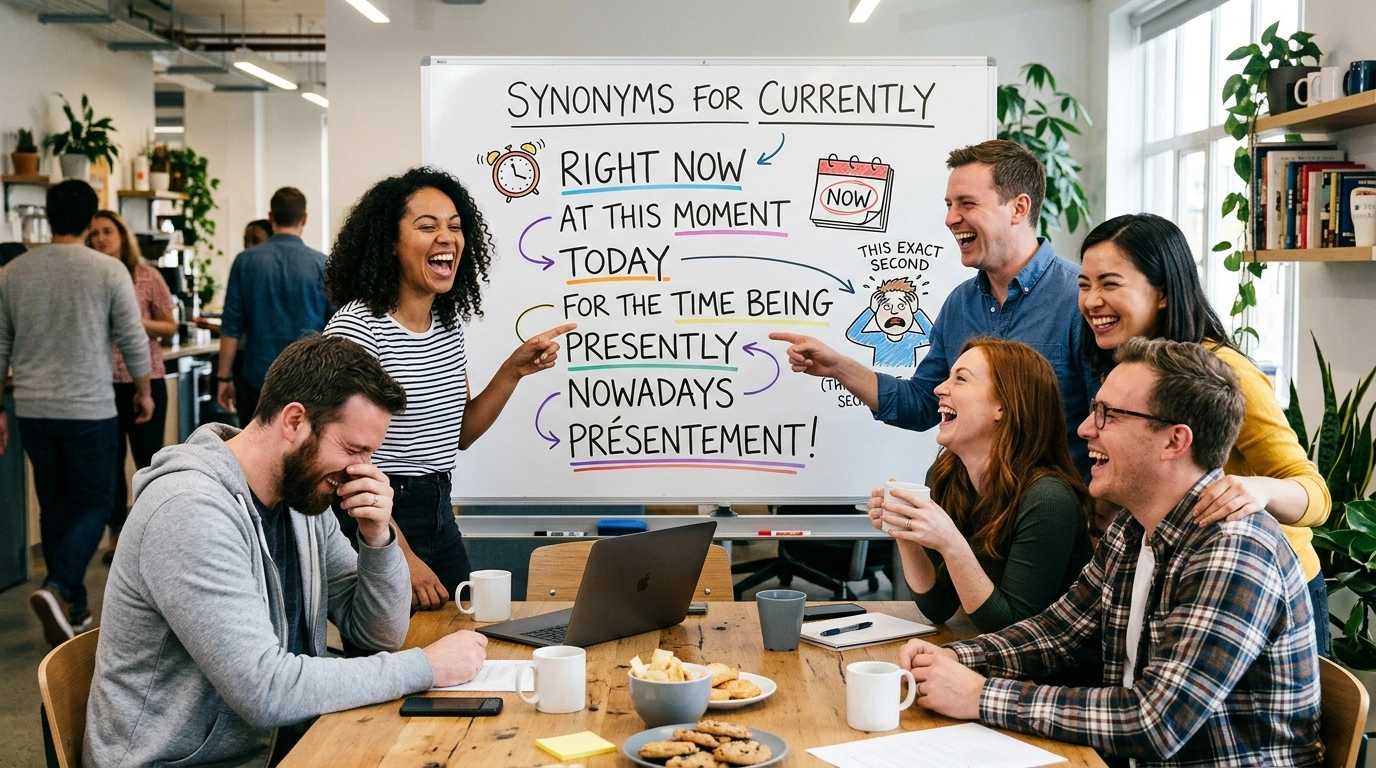
The best synonyms and alternatives for currently include:
Now
At present
Presently
At the moment
At this time
Right now
As of now
For now
At the present time
These days
Nowadays
At this point
At the current time
At this moment
In the present
For the time being
At this stage
As things stand
In recent times
Today
Quick Synonym List
| Alternative | Best Use |
|---|---|
| Now | Simple reference to the present |
| At present | Formal reference to the current situation |
| Presently | Formal or neutral reference to now |
| At the moment | Something happening around now |
| At this time | Neutral or formal present reference |
| Right now | Emphasizes this exact moment |
| As of now | Current status or situation |
| For now | Temporary situation |
| At the present time | Formal and explicit |
| These days | A broader period around the present |
| Nowadays | Current general trends or habits |
| At this point | Current stage or situation |
| For the time being | Temporary present condition |
| As things stand | Current circumstances or status |
| Today | The present day or modern period |
What Does Currently Mean?
Currently is an adverb that means at the present time or now.
For example:
She is currently working on a new project.
This means:
She is now working on a new project.
The word can refer to the exact present moment or to a period that includes the present, depending on context.
1. Now
Now is the simplest and most common alternative to currently.
Example:
The store is currently closed.
→ The store is now closed.
It is natural in everyday speech and writing.
2. At Present
At present is a close synonym and often sounds more formal than now.
Example:
The company is currently reviewing the proposal.
→ The company is at present reviewing the proposal.
It works well in professional and formal writing.
3. Presently
Presently can mean currently or soon, depending on regional usage and context.
In the sense of currently:
The manager is presently unavailable.
Because presently can also mean “soon,” currently or at present may sometimes be clearer.
4. At the Moment
At the moment means around the current time.
Example:
I am currently busy.
→ I am busy at the moment.
It is very common in everyday English.
5. At This Time
At this time is a neutral alternative that works especially well in formal communication.
Example:
We are currently unable to process your request.
→ We are unable to process your request at this time.
This phrasing is common in customer service and business communication.
6. Right Now
Right now emphasizes the present moment more strongly than currently.
Example:
I am currently working.
→ I am working right now.
It is more conversational and should usually be avoided in highly formal writing.
7. As of Now
As of now refers to the current status of something.
Example:
Currently, no decision has been made.
→ As of now, no decision has been made.
It is especially useful when a situation may change later.
8. For Now
For now means something is true temporarily and may change later.
Example:
She is currently living in London.
If the situation is temporary:
She is living in London for now.
Unlike currently, for now specifically suggests a temporary arrangement.
9. At the Present Time
At the present time is a formal and explicit alternative.
Example:
The system is currently unavailable.
→ The system is unavailable at the present time.
It can sound more formal than necessary in casual writing.
10. These Days
These days refers to the current period rather than necessarily this exact moment.
Example:
People currently use smartphones for many daily tasks.
→ These days, people use smartphones for many daily tasks.
It is useful when discussing current habits, trends, or lifestyles.
11. Nowadays
Nowadays means in the present period, especially when contrasting current conditions with the past.
Example:
Currently, people communicate online more often.
→ Nowadays, people communicate online more often.
It generally describes broader present-day trends rather than an action happening at this exact moment.
12. At This Point
At this point means at the current stage or situation.
Example:
We currently have no plans to expand.
→ At this point, we have no plans to expand.
It is particularly useful for decisions, plans, processes, and situations that may develop.
13. At This Moment
At this moment directly refers to the present moment.
Example:
She is currently unavailable.
→ She is unavailable at this moment.
It can sound slightly more dramatic or formal than right now.
14. For the Time Being
For the time being means temporarily, until circumstances change.
Example:
He is currently working from home.
If the arrangement is temporary:
He is working from home for the time being.
It should not replace currently when there is no implication of temporary circumstances.
15. As Things Stand
As things stand means according to the current situation.
Example:
Currently, the project will continue as planned.
→ As things stand, the project will continue as planned.
This is particularly useful when discussing decisions, plans, or changing circumstances.
Currently by Context
| Context | Best Alternatives |
|---|---|
| Everyday conversation | Now, right now, at the moment |
| Formal writing | At present, presently, at this time |
| Business | At present, as of now, at this time |
| Current status | As of now, at this point, as things stand |
| Temporary situation | For now, for the time being |
| Current trends | Nowadays, these days |
| Exact present moment | Right now, at this moment |
| Academic writing | Currently, at present, at this time |
Currently vs Now
Now and currently are very close.
The company is currently hiring.
The company is now hiring.
Both are correct.
However, now is generally simpler and more conversational, while currently often sounds more neutral or formal.
Currently vs At Present
These are usually interchangeable.
The museum is currently closed.
The museum is closed at present.
At present has a somewhat more formal tone and is common in professional and academic writing.
Currently vs Presently
Presently can mean currently, but it can also mean soon.
For example:
The manager will speak presently.
Here, presently can mean “soon.”
Because of this potential ambiguity, currently is often preferable when you specifically mean “now.”
Currently vs At the Moment
At the moment is often used for situations happening around now.
I am currently studying.
I am studying at the moment.
Both are natural.
However, at the moment is more conversational.
Currently vs Nowadays
These words are not exact synonyms.
Currently can describe a situation happening now:
She is currently working from home.
Nowadays generally describes present-day habits or trends:
Nowadays, many people work from home.
Use nowadays when comparing the present with the past or discussing broader trends.
Currently vs These Days
These days usually refers to a broader period around the present.
He is currently studying medicine.
describes his present situation.
These days, he studies mostly online.
describes his current routine or circumstances.
Currently vs As of Now
Currently simply means at present.
As of now often emphasizes the current status of something that may change.
The project is currently delayed.
As of now, the project is delayed.
The second sentence can imply that this is the latest known status.
Currently vs For Now
These have different meanings.
Currently = at the present time.
For now = temporarily, for the present period.
Compare:
She is currently living in Canada.
This does not necessarily mean she plans to leave.
She is living in Canada for now.
This suggests the arrangement may change.
Formal and Professional Alternatives to Currently
For business emails, reports, applications, and professional documents, consider:
At present
At this time
At the present time
As of now
At this stage
As things stand
At this point
Presently
Example:
Instead of:
We are currently reviewing your application.
You could write:
We are at present reviewing your application.
Or:
We are reviewing your application at this time.
Academic Alternatives to Currently
Academic writing can use:
Currently
At present
At this time
In the present period
In contemporary society
In recent years
Nowadays
The correct choice depends on whether you are referring to the exact present or a broader historical period.
Example:
Currently, researchers are examining the effects of artificial intelligence.
A broader version:
In recent years, researchers have increasingly examined the effects of artificial intelligence.
These are not always interchangeable because in recent years refers to a period extending into the past.
Casual Alternatives to Currently
Natural conversational alternatives include:
Now
Right now
At the moment
These days
For now
Example:
Formal:
I am currently unavailable.
Casual:
I’m busy right now.
Stronger Alternatives to Currently
There are few true “stronger” synonyms because currently mainly indicates time rather than intensity. However, you can add emphasis with:
Right now
At this very moment
As of this moment
At present
At this point
Example:
The system is currently unavailable.
Stronger emphasis:
The system is unavailable right now.
Simpler Alternatives to Currently
For easy-to-read writing, use:
Now
At the moment
Right now
These days
For now
Example:
The website is currently unavailable.
Simpler:
The website is not available right now.
Sentence Transformations Using Currently Synonyms
Original
She is currently studying at university.
Alternative
She is now studying at university.
Original
The office is currently closed.
Alternative
The office is closed at the moment.
Original
The company is currently hiring.
Alternative
The company is hiring at present.
Original
No decision has currently been made.
Alternative
As of now, no decision has been made.
Original
He is currently working from home.
Alternative
He is working from home for the time being.
Original
People currently rely heavily on digital communication.
Alternative
Nowadays, people rely heavily on digital communication.
Original
The project is currently under review.
Alternative
The project is at this point under review.
Original
We are currently unable to provide an answer.
Alternative
We are unable to provide an answer at this time.
Grammar and Usage of Currently
Currently is an adverb.
It commonly appears before the main verb:
She currently works in marketing.
It can also appear after the verb be:
She is currently working.
It can appear at the beginning of a sentence:
Currently, the company operates three offices.
Or at the end, although this can sometimes sound less natural:
The company operates three offices currently.
For most writing, placing currently near the verb or at the beginning of the sentence is clearer.
Common Collocations With Currently
Common expressions include:
Currently available
Currently working
Currently studying
Currently living
Currently operating
Currently employed
Currently enrolled
Currently experiencing
Currently under review
Currently under development
Currently in use
Currently active
Currently unavailable
Currently seeking
Currently offering
Currently accepting
Currently serving
Currently experiencing growth
Currently being developed
Currently being used
Common Mistakes With Currently
Using Currently and Now Together Unnecessarily
Avoid unnecessary repetition such as:
She is currently working now.
Usually choose one:
She is currently working.
or:
She is working now.
Confusing Currently With Nowadays
Currently can describe a present situation, while nowadays usually refers to broader present-day conditions.
I currently work from home.
is about one person’s present situation.
Nowadays, many people work from home.
is about a broader trend.
Using Presently When You Mean Soon
Because presently can mean “soon,” it may create ambiguity.
If you clearly mean “now,” currently or at present is often safer.
Using For Now Without a Temporary Meaning
For now suggests that a situation is temporary.
If you only mean “at the present time,” use currently.
Overusing Currently
You do not need currently in every sentence describing the present.
Instead of:
The company currently offers three services. Currently, the company currently serves…
Use the word only when the time reference adds useful information.
When You Should Not Replace Currently
Sometimes currently is the most precise choice.
For example:
The software is currently being tested.
This clearly communicates that testing is happening at the present time.
Replacing it with nowadays would be incorrect because nowadays describes a broader period.
Likewise, replacing it with for now would add a temporary meaning that may not be intended.
How to Choose the Right Synonym for Currently
Choose now for simple, everyday writing.
Choose at present for a formal or professional tone.
Choose presently when the context clearly supports the meaning “currently.”
Choose at the moment for natural conversational English.
Choose right now when emphasizing the exact present moment.
Choose as of now when describing the latest status.
Choose for now when the situation is temporary.
Choose these days for current routines, habits, or circumstances.
Choose nowadays for broader present-day trends.
Choose at this point when discussing a current stage or decision.
Choose as things stand when describing the current situation.
Choose for the time being when emphasizing a temporary arrangement.