
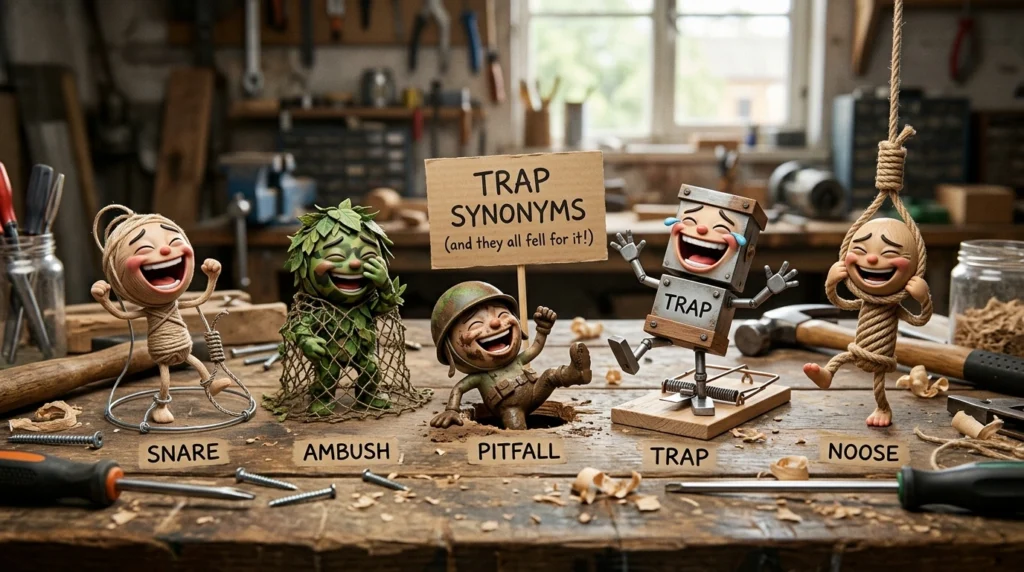
Quick Answer: What Are the Best Synonyms for Trap?
| Synonym | Best Used For |
|---|---|
| Snare | Device or method for catching someone or something |
| Pitfall | Hidden problem or danger |
| Ambush | Surprise attack or surprise capture |
| Predicament | Difficult situation |
| Plight | Serious or difficult situation |
| Dilemma | Difficult choice between options |
| Catch | Something that captures or limits |
| Trick | Deceptive method |
| Deception | Deliberate misleading |
| Scheme | Planned strategy, often dishonest |
| Ruse | Clever deceptive tactic |
| Stratagem | Carefully planned tactic |
| Bait | Something used to lure someone |
| Lure | Something that attracts or tempts |
| Entanglement | Situation that is difficult to escape |
| Confinement | State of being restricted |
| Restraint | Something that limits movement |
| Cage | Physical enclosure |
| Net | Device or method for catching |
| Impasse | Situation with no easy way forward |
| Bind | Difficult situation or restriction |
| Capture | Act of catching |
| Corner | Put someone in a position from which escape is difficult |
| Block | Prevent movement or escape |
| Ensnare | Catch or deceive |
| Entrap | Catch or place in a difficult situation |
| Detain | Prevent someone from leaving |
What Does Trap Mean?
The word trap has several meanings.
As a noun, it can mean:
A device used to catch an animal or person.
A hidden danger or problem.
A difficult situation that is hard to escape.
A deceptive plan intended to catch someone.
Examples:
The hunter set a trap.
The hidden fee was a trap for inexperienced buyers.
He found himself in a difficult trap.
As a verb, trap can mean:
to catch
to confine
to restrict
to corner
to deceive
to prevent escape
Best Synonyms for Trap
1. Snare
A snare is a device or method used to catch something, especially an animal. It can also describe a situation that catches someone metaphorically.
Example:
The animal became caught in a snare.
Best for: Physical traps, hunting, and figurative situations.
2. Pitfall
A pitfall is a hidden problem, danger, or difficulty that someone may encounter.
Example:
Poor planning can create serious pitfalls for a new business.
Best for: Mistakes, hidden dangers, and difficult situations.
3. Ambush
An ambush is a surprise attack in which someone waits for another person and attacks unexpectedly.
Example:
The soldiers were caught in an ambush.
Best for: Military, violent, historical, and figurative contexts.
4. Predicament
A predicament is a difficult or unpleasant situation that is hard to escape.
Example:
She found herself in a difficult predicament.
Best for: Personal, professional, and everyday problems.
5. Plight
A plight is a difficult, dangerous, or unfortunate situation.
Example:
The organization worked to improve the plight of displaced families.
Best for: Serious problems and difficult circumstances.
6. Dilemma
A dilemma is a difficult situation involving a difficult choice between alternatives.
Example:
He faced a dilemma between keeping his job and moving abroad.
Best for: Difficult decisions.
Important: A dilemma is not exactly the same as a trap. It emphasizes a difficult choice rather than being caught.
7. Catch
A catch can describe something that limits a person’s options or creates an unexpected problem.
Example:
The offer sounds attractive, but there is a catch.
Best for: Hidden conditions, disadvantages, and informal speech.
8. Trick
A trick is an action intended to deceive someone.
Example:
The advertisement used a trick to attract customers.
Best for: Deception and misleading tactics.
9. Deception
Deception means deliberately causing someone to believe something that is not true.
Example:
The entire scheme was based on deception.
Best for: Formal writing and dishonest behavior.
10. Scheme
A scheme is a carefully planned action or plan, especially one that is dishonest or harmful.
Example:
The criminals created a scheme to steal money.
Best for: Fraud, deception, and secret plans.
11. Ruse
A ruse is a clever trick used to deceive someone.
Example:
The invitation was merely a ruse to get him into the building.
Best for: Clever deception and formal or literary writing.
12. Stratagem
A stratagem is a carefully planned tactic used to achieve a goal, often through cleverness or deception.
Example:
The commander used a clever stratagem to outmaneuver the enemy.
Best for: Strategy, military writing, history, and formal contexts.
13. Bait
Bait is something used to attract or lure someone or something into a trap.
Example:
The fisherman placed bait on the hook.
Best for: Physical traps, fishing, hunting, and figurative situations.
14. Lure
A lure is something that attracts or tempts someone into doing something.
Example:
The promise of easy money was a lure.
Best for: Attraction, temptation, and deceptive situations.
15. Entanglement
An entanglement is a complicated situation that is difficult to escape from.
Example:
He became involved in a legal entanglement.
Best for: Complicated relationships, legal problems, and difficult situations.
16. Confinement
Confinement is the state of being restricted or prevented from moving freely.
Example:
The animal remained in confinement.
Best for: Physical restriction, imprisonment, and formal contexts.
17. Restraint
A restraint is something that limits movement, freedom, or action.
Example:
The safety device acts as a restraint.
Best for: Physical, legal, social, and figurative restrictions.
18. Cage
A cage is an enclosure used to contain a person or animal.
Example:
The bird was kept in a cage.
Best for: Physical confinement and figurative descriptions.
19. Net
A net can be a physical device used to catch animals or fish. It can also be used figuratively for a system designed to catch or identify people or things.
Example:
The fishermen cast a net into the water.
Best for: Physical capture and figurative systems.
20. Impasse
An impasse is a situation in which no progress or solution seems possible.
Example:
The negotiations reached an impasse.
Best for: Negotiations, disagreements, and difficult situations.
Synonyms for Trap as a Physical Device
When trap refers to a device used to catch an animal or person, useful alternatives include:
Snare
Net
Cage
Catcher
Device
Enclosure
Baited mechanism
Restraint
Example
The hunter placed a trap in the forest.
Possible alternatives:
The hunter placed a snare in the forest.
The hunter set a baited device in the forest.
Snare is usually the closest alternative when referring specifically to a catching device.
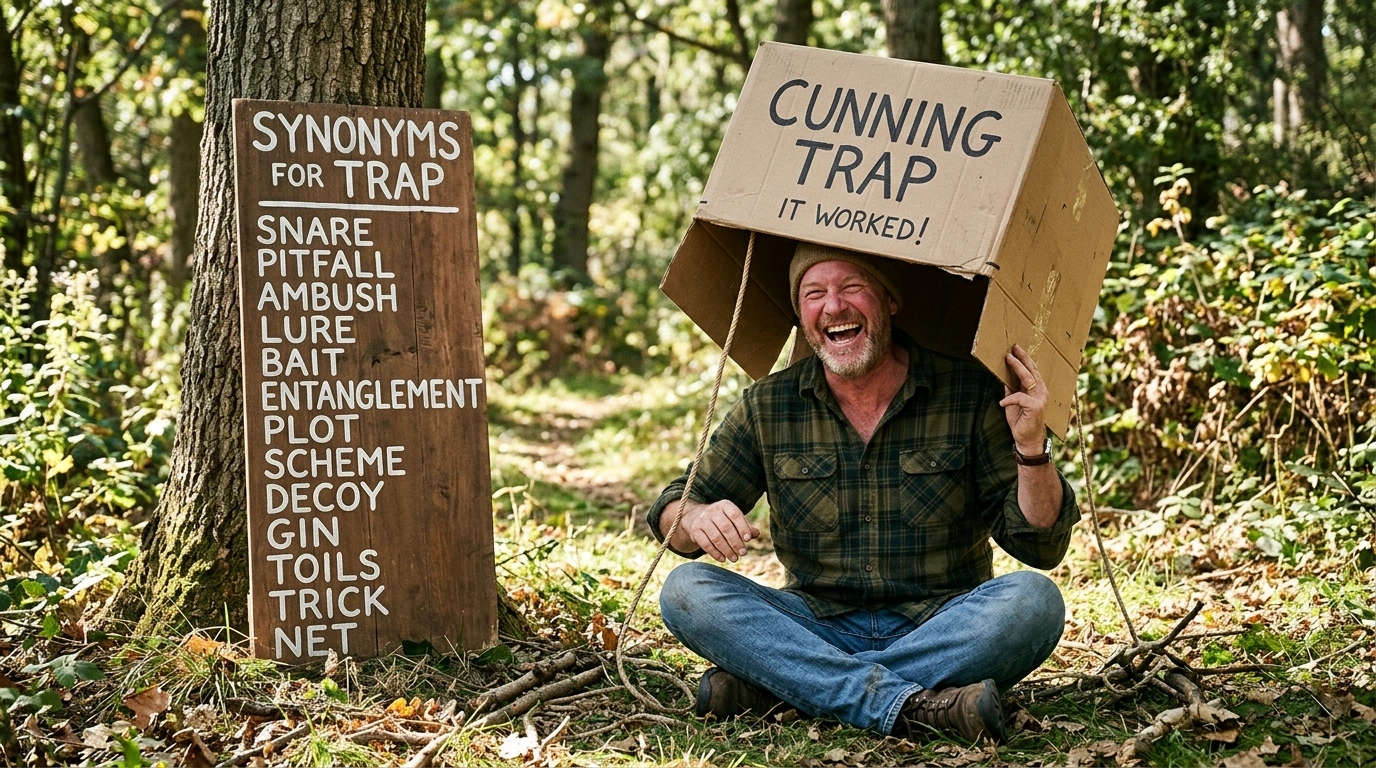
Synonyms for Trap as a Hidden Danger
When trap means a hidden problem or danger, use:
Pitfall
Hazard
Danger
Risk
Catch
Complication
Obstacle
Hidden problem
Snare
Example
Lack of preparation can become a trap for inexperienced students.
A more natural alternative might be:
Lack of preparation can become a pitfall for inexperienced students.
Synonyms for Trap as a Difficult Situation
When someone feels stuck in a difficult situation, useful alternatives include:
Predicament
Plight
Bind
Dilemma
Impasse
Entanglement
Difficult situation
Tight spot
Dead end
Example
He found himself trapped in a difficult situation.
Possible alternatives:
He found himself in a predicament.
He found himself in a tight spot.
He found himself in a difficult bind.
Synonyms for Trap as Deception
When trap means a deceptive plan, consider:
Trick
Ruse
Deception
Scheme
Stratagem
Ploy
Maneuver
Tactic
Example
The offer was a trap.
Possible alternatives:
The offer was a ruse.
The offer was a deceptive scheme.
The offer was a ploy.
Synonyms for Trap in Business
In business, trap often refers to a hidden problem, unfavorable condition, or deceptive offer.
Useful alternatives include:
Pitfall
Catch
Risk
Hidden condition
Complication
Disadvantage
Liability
Snare
Example
The low-cost contract turned out to be a trap.
A more professional version:
The low-cost contract contained a significant pitfall.
Or:
The contract included a hidden condition.
Synonyms for Trap in Relationships
In relationships, trap can describe a situation in which someone feels stuck, manipulated, or unable to leave.
Possible alternatives include:
Bind
Entanglement
Predicament
Difficult situation
Confinement
Restriction
Complication
Example
He felt trapped in the relationship.
More specific:
He felt stuck in the relationship.
He found himself in a complicated entanglement.
Synonyms for Trap in Legal Contexts
In legal writing, more precise terms may include:
Predicament
Liability
Restriction
Confinement
Entrapment
Complication
Legal bind
Constraint
Entrapment has a specific legal meaning and should not be used simply as a general synonym for trap.
Synonyms for Trap in Casual Conversation
For everyday speech, natural alternatives include:
Catch
Trick
Snare
Bind
Tight spot
Sticky situation
Bad situation
Dead end
Example
There’s a trap in this deal.
More casually:
There’s a catch in this deal.
This deal could put you in a tight spot.
Trap vs. Snare
A snare is specifically designed to catch something, especially an animal.
A trap is broader and can describe physical devices, deceptive situations, or difficult circumstances.
The rabbit was caught in a snare.
The offer was a trap.
Snare cannot replace trap in every context.
Trap vs. Pitfall
A pitfall is a hidden problem or danger.
Lack of research is a common pitfall.
A trap can also be a hidden danger, but it has a broader meaning.
The contract contained a trap.
The contract contained several potential pitfalls.
Trap vs. Ambush
An ambush involves surprising someone, usually in order to attack or capture them.
The soldiers were caught in an ambush.
A trap does not necessarily involve an attack.
The animal was caught in a trap.
Trap vs. Dilemma
A dilemma involves a difficult choice.
She faced a dilemma.
A trap can describe a situation from which escape is difficult.
She felt trapped by the circumstances.
A difficult choice is not automatically a trap.
Trap vs. Predicament
A predicament is a difficult situation.
He found himself in a serious predicament.
A trap emphasizes that someone has been caught or restricted, while predicament focuses on the difficulty of the situation itself.
Trap vs. Trick
A trick is an action used to deceive someone.
A trap may use deception, but its main purpose is usually to catch, restrict, or prevent escape.
The advertisement was a trick.
The advertisement was a trap.
The second sentence suggests that the person was drawn into an unfavorable situation.
Trap vs. Entrapment
Entrapment means the act or process of trapping someone. In legal contexts, it can have a specific meaning involving law enforcement inducing someone to commit a crime they otherwise would not commit.
Therefore, entrapment should not be treated as an ordinary synonym in every sentence.
8 Sentence Transformations Using Synonyms for Trap
1. Trap → Snare
Original:
The animal was caught in a trap.
Alternative:
The animal was caught in a snare.
2. Trap → Pitfall
Original:
Poor planning can become a trap.
Alternative:
Poor planning can become a pitfall.
3. Trap → Predicament
Original:
He found himself in a trap.
Alternative:
He found himself in a difficult predicament.
4. Trap → Trick
Original:
The offer was a trap.
Alternative:
The offer was a trick.
5. Trap → Ruse
Original:
The invitation was a trap.
Alternative:
The invitation was a ruse.
6. Trap → Catch
Original:
There must be a trap in the deal.
Alternative:
There must be a catch in the deal.
7. Trap → Entanglement
Original:
She became trapped in a complicated situation.
Alternative:
She became involved in a complicated entanglement.
8. Trap → Ambush
Original:
The soldiers walked into a trap.
Alternative:
The soldiers walked into an ambush.
This works when the trap specifically involves a surprise attack.
Common Mistakes When Using Synonyms for Trap
Using “pitfall” for a physical trap
A pitfall usually means a hidden problem or danger in modern general usage.
Lack of preparation is a pitfall.
For a physical catching device, trap or snare is more appropriate.
Using “dilemma” for every difficult situation
A dilemma involves difficult choices.
She faced a dilemma between two jobs.
A person can be in a difficult situation without facing a dilemma.
Using “trick” when there is no deception
A trap can work without deliberately deceiving someone.
A trick, however, usually involves some form of deception or cleverness.
Using “ambush” for ordinary traps
An ambush specifically involves surprising someone, often with an attack.
A simple physical trap is not necessarily an ambush.
Using “entrapment” casually
Entrapment has a specific meaning in legal contexts and should be used carefully.
Grammar and Usage of Trap
Trap can function as both a noun and a verb.
Trap as a noun
The animal escaped the trap.
The contract contains a hidden trap.
Trap as a verb
The cage trapped the animal.
He felt trapped in the situation.
Common forms include:
trap
traps
trapped
trapping
Common verb patterns
trap someone
trap an animal
trap someone inside
trap someone in a situation
become trapped
feel trapped
get trapped
be trapped
Common Collocations With Trap
Natural phrases with trap include:
set a trap
lay a trap
fall into a trap
avoid a trap
escape a trap
spring a trap
hidden trap
deadly trap
dangerous trap
clever trap
physical trap
financial trap
legal trap
emotional trap
common trap
potential trap
carefully designed trap
trap someone
trap an animal
become trapped
feel trapped
get trapped
When to Use Each Synonym
Use snare for a device designed to catch something.
Use pitfall for a hidden problem or danger.
Use ambush for a surprise attack or capture.
Use predicament for a difficult situation.
Use plight for a serious or unfortunate situation.
Use dilemma when someone faces a difficult choice.
Use catch for a hidden disadvantage or condition.
Use trick for deception.
Use ruse for a clever deceptive tactic.
Use scheme for a planned action, especially a dishonest one.
Use bait for something used to lure someone or something.
Use lure for something attractive that draws someone in.
Use entanglement for a complicated situation that is difficult to escape.
Use confinement for restriction of movement or freedom.
Use restraint for something that limits action or movement.
How to Choose the Right Synonym for Trap
Ask what you mean by trap:
A physical device for catching something? → Use snare.
A hidden danger or problem? → Use pitfall.
A surprise attack? → Use ambush.
A difficult situation? → Use predicament or plight.
A difficult choice? → Use dilemma.
A deceptive action? → Use trick or ruse.
A hidden disadvantage? → Use catch.
Something used to attract someone? → Use bait or lure.
A complicated situation? → Use entanglement.
A restriction on freedom or movement? → Use confinement or restraint.
Related Words to Trap
These words are closely related to trap:
Snare
Pitfall
Ambush
Predicament
Plight
Dilemma
Catch
Trick
Ruse
Scheme
Stratagem
Ploy
Bait
Lure
Entanglement
Confinement
Restraint
Cage
Net
Impasse
Bind
Capture
Entrapment
Restriction
Constraint
Not all of these are exact synonyms. Some describe physical traps, while others describe deception, restriction, danger, or difficult situations.