
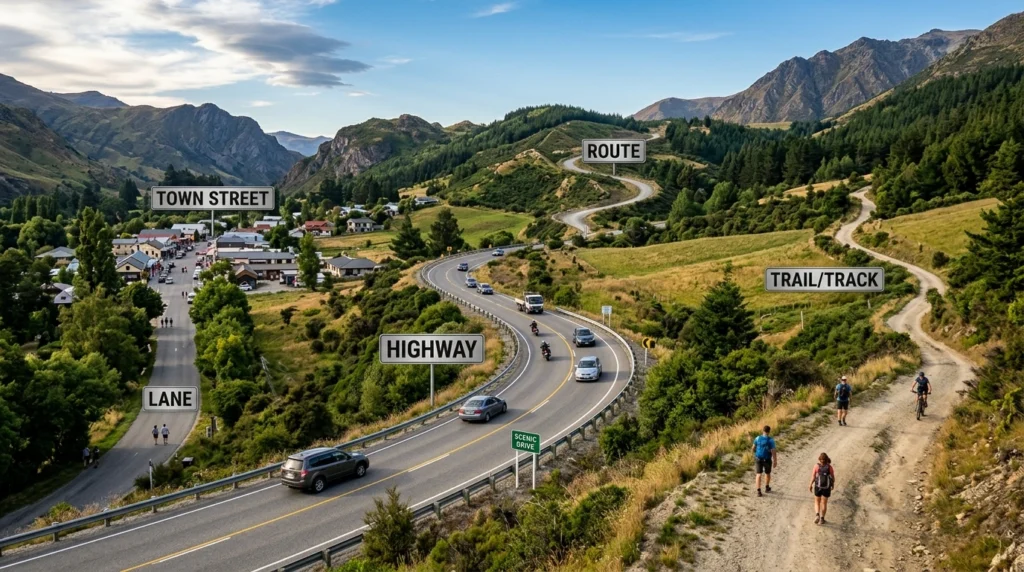
Quick Answer: What Is a Synonym for Road?
Some of the closest synonyms and alternatives for road include:
Street
Route
Highway
Roadway
Avenue
Lane
Path
Track
Way
Drive
Boulevard
Parkway
Turnpike
Freeway
Expressway
Causeway
Passage
Thoroughfare
Trail
Course
Journey
Direction
Routeway
Artery
Access road
Bypass
Motorway
Side road
Byway
Pathway
The best choice depends on the type of road and the meaning you want to convey.
Quick Synonym List for Road
| Synonym | Best meaning or use |
|---|---|
| Street | Road in a town or city |
| Route | A course or direction of travel |
| Highway | Major public road connecting places |
| Roadway | The part of a road used for vehicles |
| Avenue | Broad urban street |
| Lane | Narrow road or street |
| Path | Narrow route for walking or travel |
| Track | Rough or narrow route |
| Way | General route or direction |
| Boulevard | Wide urban road, often landscaped |
| Parkway | Road designed for scenic or controlled travel |
| Freeway | High-speed road with controlled access |
| Expressway | Major high-speed road |
| Motorway | British term for a controlled-access highway |
| Turnpike | Toll road or major highway |
| Thoroughfare | Main route through a place |
| Trail | Route through natural terrain |
| Byway | Less-traveled or secondary road |
| Bypass | Road that avoids a congested area |
| Causeway | Raised road across low or wet land |
| Passage | A route through or between places |
Closest Synonyms for Road
1. Street
Street is one of the most common alternatives to road. It usually refers to a public road in a town, city, or built-up area.
Example:
“The restaurant is on the main street.”
Use street when referring to an urban road, especially one lined with buildings, businesses, homes, or sidewalks.
2. Route
Route refers to a particular way or course used to travel from one place to another.
Example:
“We took a different route to avoid traffic.”
Unlike road, route focuses more on the course of travel than on the physical surface.
3. Highway
A highway is a major public road designed to carry traffic between towns, cities, or regions.
Example:
“The highway was busy during the holiday weekend.”
In American English, highway can describe various major roads, while terminology differs by region.
4. Roadway
Roadway refers specifically to the part of a road intended for vehicles.
Example:
“Drivers should remain within their lane on the roadway.”
It is more technical than road and is common in transportation, engineering, and legal contexts.
5. Avenue
An avenue is typically a broad street in a town or city.
Example:
“The hotel is located on a busy avenue.”
The exact distinction between a street and an avenue varies by location, so avenue is not a universal synonym for every road.
6. Lane
A lane can refer to a narrow road, especially in a rural area or residential neighborhood.
Example:
“We drove down a quiet country lane.”
It can also mean one section of a larger road:
“Stay in the left lane.”
7. Path
A path is generally narrower than a road and may be intended for walking, cycling, or limited travel.
Example:
“We followed a path through the forest.”
It can also be used figuratively:
“Education can create a path to opportunity.”
8. Track
A track can describe a rough or narrow route, especially one that is not fully paved.
Example:
“The vehicle traveled along a muddy track.”
It is common for rural, agricultural, or off-road routes.
9. Way
Way is a broad and flexible word for a route or direction.
Example:
“Is this the best way to the station?”
It can also be figurative:
“There is always a way forward.”
10. Boulevard
A boulevard is usually a wide urban road, often with landscaping, trees, or a central divider.
Example:
“They walked along the tree-lined boulevard.”
It is more specific than road and should not be used for every street.
Formal and Technical Alternatives for Road
For technical, transportation, geographic, or professional writing, these alternatives can provide greater precision.
Roadway
Best when referring specifically to the vehicle-use portion of a road.
“Construction workers closed the roadway.”
Thoroughfare
A thoroughfare is a public route or main passage through a place.
“The road is one of the city’s busiest thoroughfares.”
This word is formal and often appears in urban planning or descriptive writing.
Artery
An arterial road is a major route designed to carry substantial traffic.
“The arterial connects several major neighborhoods.”
Artery can also be used metaphorically for an important transportation route.
Access Road
An access road provides entry to a particular location, facility, highway, or property.
“Use the access road to reach the industrial park.”
Bypass
A bypass is a road designed to allow traffic to avoid a town, city center, or congested section.
“The new bypass reduced traffic in the town center.”
Expressway
An expressway is a major high-speed road with limited access.
“The expressway provides a faster connection between the two cities.”
Freeway
In American English, a freeway generally refers to a controlled-access highway without tolls.
“The freeway was crowded during rush hour.”
Parkway
A parkway is generally a broad, landscaped road, often designed for scenic travel or controlled access.
“The parkway follows the river.”
Neutral and Everyday Alternatives for Road
For everyday writing and conversation, these words are usually natural:
Street
Route
Way
Roadway
Lane
Path
Highway
Avenue
Drive
Boulevard
Track
For example:
Original:
“We found a quiet road through the countryside.”
Alternative:
“We found a quiet country lane.”
Or:
“We found a quiet route through the countryside.”
The first focuses on the physical road, while the second focuses more on the journey.
Casual Alternatives for Road
In informal speech, people may use:
Way
Route
Street
Path
Track
Side road
Back road
Country lane
Drive
Examples:
“Let’s take the back road.”
“Which way are you going?”
“There’s a shortcut down this path.”
These expressions are often more natural in conversation than formal terms such as thoroughfare or arterial.
Types of Roads and Their Alternatives
Not every road synonym refers to the same kind of road. Here are some useful distinctions.
Highway
A major road connecting cities, towns, or regions.
“We spent three hours on the highway.”
Freeway
A controlled-access highway, generally without intersections at street level.
“Take the freeway north.”
Expressway
A major road designed for relatively fast traffic with limited access.
“The expressway connects the airport to the city.”
Motorway
A common term for a controlled-access highway in British English and some other varieties.
“The motorway was closed because of an accident.”
Turnpike
A major road, traditionally associated with toll collection.
“The turnpike is the fastest route to the city.”
Boulevard
A broad urban road, often landscaped.
“The boulevard is lined with trees.”
Avenue
A broad or significant urban street, although local naming conventions vary.
“The museum is on Fifth Avenue.”
Lane
A narrow road or street.
“They live on a quiet country lane.”
Bypass
A road that allows traffic to avoid a town or congested area.
“Take the bypass around the city.”
Causeway
A raised road or path across low, wet, or flooded land.
“The causeway crosses the marsh.”
Trail
A route through natural surroundings, generally for walking, cycling, hiking, or similar activities.
“The hiking trail follows the river.”
Track
A rough or unpaved route.
“The farm is accessible by a dirt track.”
Road vs. Street
Road is a broad term for a route designed for travel.
Street generally refers to a road within a town or city, often surrounded by buildings.
Compare:
“We drove along a mountain road.”
“The store is on Main Street.”
A mountain route is naturally called a road, while an urban route may naturally be called a street.
However, these distinctions are not absolute. Local naming conventions can vary.
Road vs. Route
A road is usually a physical transportation structure.
A route is the course or direction used to travel.
Compare:
“The road was damaged by the storm.”
“We changed our route because of the storm.”
The road is the physical infrastructure; the route is the chosen way of getting somewhere.
Road vs. Path
A road is generally designed for vehicles.
A path is usually narrower and may be designed for pedestrians, cyclists, or limited access.
Compare:
“The road leads to the village.”
“The path leads to the lake.”
Calling a major highway a path would normally be inaccurate.
Road vs. Highway
A highway is a type of major road.
Therefore, highway is not always interchangeable with road.
“A small road runs through the village.”
Calling it a highway would imply a larger, more significant transportation route.
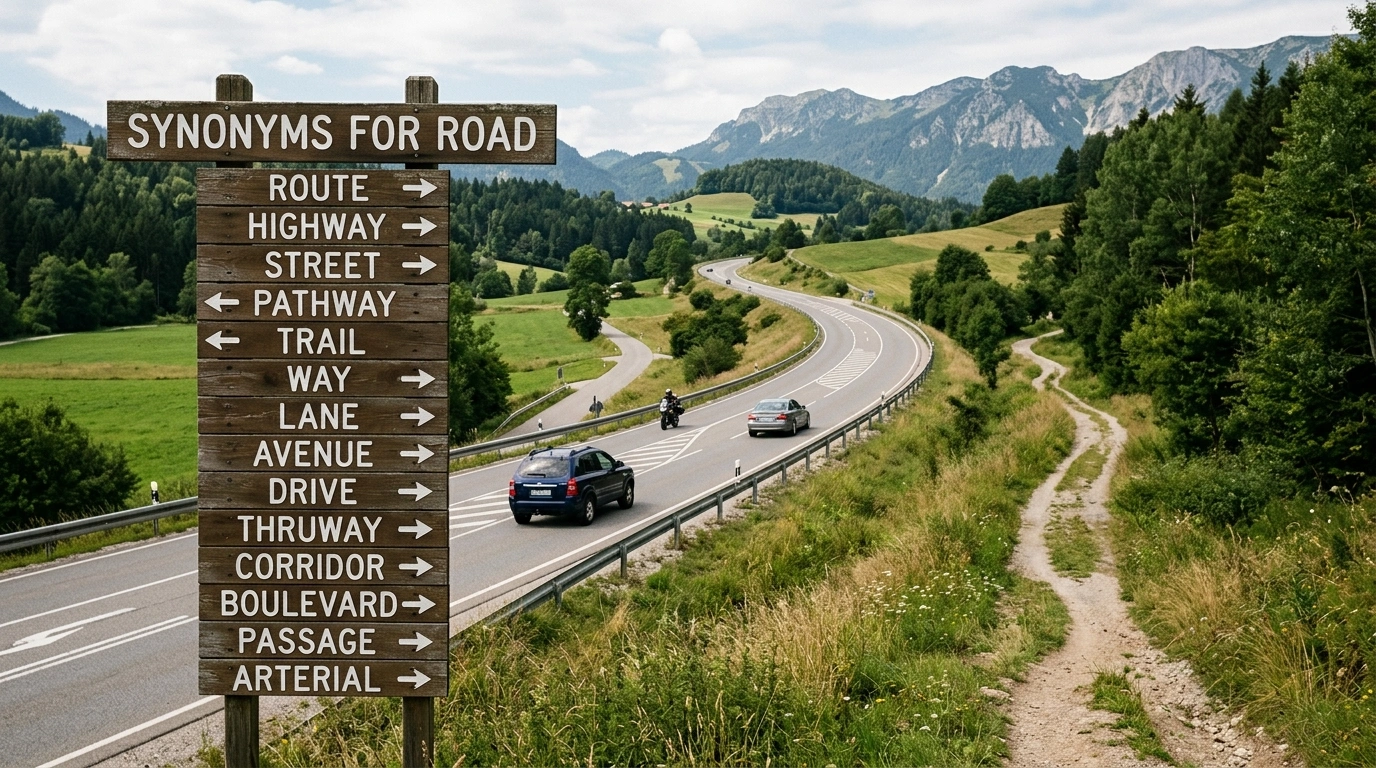
Road vs. Way
Way is broader and can describe a physical route, direction, method, or figurative journey.
“Which way should we go?”
“There is a way to solve the problem.”
Because way has several meanings, it is less precise than road when discussing physical infrastructure.
Road vs. Lane
A lane usually suggests a narrower road or one section of a larger road.
“They live on a quiet lane.”
But:
“Stay in the right lane.”
Here, lane means a marked portion of a larger roadway rather than an independent road.
Road vs. Boulevard
A boulevard is typically a broad urban road, often with landscaping or a median.
“The boulevard is lined with trees.”
Calling every road a boulevard would be inaccurate because the term describes a particular type of urban street.
Comparison Table: Synonyms for Road
| Word | Physical Road? | Typical Setting | Main Meaning |
|---|---|---|---|
| Road | Yes | General | General travel route |
| Street | Yes | Urban | City or town road |
| Highway | Yes | Regional | Major public road |
| Route | Sometimes | General | Course of travel |
| Roadway | Yes | Technical | Vehicle-use surface |
| Avenue | Yes | Urban | Broad city street |
| Lane | Yes | Rural/Urban | Narrow road or traffic section |
| Path | Sometimes | Natural/Urban | Narrow route |
| Track | Yes | Rural | Rough or unpaved route |
| Boulevard | Yes | Urban | Wide, often landscaped road |
| Parkway | Yes | Urban/Scenic | Landscaped or controlled road |
| Freeway | Yes | Regional | Controlled-access highway |
| Expressway | Yes | Regional | High-speed major road |
| Bypass | Yes | Urban outskirts | Route around congestion |
| Causeway | Yes | Wetlands/Water | Raised route |
| Trail | Sometimes | Natural | Route for walking/cycling |
| Thoroughfare | Yes | Urban | Main public route |
| Byway | Yes | Rural | Secondary or scenic route |
Figurative Synonyms for Road
The word road is often used metaphorically to describe progress, direction, or a journey through life.
In these contexts, physical-road synonyms may not work. Instead, consider:
Path
Journey
Course
Direction
Way
Route
Trajectory
Passage
Process
Progression
Pursuit
Approach
Road to Success
Instead of:
“Education is the road to success.”
You could write:
“Education is a path to success.”
Or:
“Education can provide a route to success.”
Road to Recovery
Possible alternatives include:
Path to recovery
Journey toward recovery
Route to recovery
Course toward recovery
Road to Growth
Possible alternatives:
Path to growth
Journey of growth
Route to development
Course of development
The best choice depends on whether you want to emphasize direction, experience, progress, or process.
How to Choose the Right Synonym for Road
Choose “street” for urban roads
“The café is on a busy street.”
Choose “highway” for major regional roads
“The highway connects the two cities.”
Choose “route” when focusing on travel direction
“We chose a different route.”
Choose “lane” for narrow roads
“They drove along a country lane.”
Choose “path” for narrow pedestrian routes
“A path leads through the garden.”
Choose “track” for rough or unpaved routes
“The farm can be reached by a dirt track.”
Choose “boulevard” for broad urban roads
“The boulevard is lined with trees.”
Choose “thoroughfare” for a major public route
“The avenue is a major city thoroughfare.”
Choose “path” or “journey” for figurative meanings
“She found her own path to success.”
Sentence Transformations: Replacing Road
1. Original
“We drove along a long road through the mountains.”
Alternative:
“We drove along a winding route through the mountains.”
2. Original
“The road was closed because of construction.”
Alternative:
“The roadway was closed because of construction.”
3. Original
“We took a different road to avoid traffic.”
Alternative:
“We took a different route to avoid traffic.”
4. Original
“The road runs through the center of town.”
Alternative:
“The main street runs through the center of town.”
5. Original
“They followed the road through the forest.”
Alternative:
“They followed the trail through the forest.”
6. Original
“We drove down a narrow road.”
Alternative:
“We drove down a narrow lane.”
7. Original
“The new road reduced traffic downtown.”
Alternative:
“The new bypass reduced traffic downtown.”
8. Original
“The road to success requires patience.”
Alternative:
“The path to success requires patience.”
9. Original
“The road connects several major cities.”
Alternative:
“The highway connects several major cities.”
10. Original
“She is on the road to recovery.”
Alternative:
“She is on the path to recovery.”
Grammar and Usage: How to Use Road Correctly
Road + to + destination
“This road leads to the airport.”
Road + through + place
“The road runs through the village.”
Road + along + feature
“The road follows the river.”
On the road
This can mean traveling:
“We spent most of the day on the road.”
It can also have a figurative meaning:
“The company is on the road to recovery.”
Road to + goal
This is a common metaphorical structure:
“The road to success is rarely easy.”
“They are beginning their road to recovery.”
By road
This describes transportation by road rather than air, sea, or rail.
“The goods were transported by road.”
Common Mistakes With Synonyms for Road
Mistake 1: Treating every road synonym as interchangeable
A highway, lane, trail, and path describe different types of routes.
“We walked along a hiking trail.”
is natural.
“We walked along a highway.”
may be possible, but it describes a completely different situation and may be unsafe.
Mistake 2: Confusing route with road
A route is the course of travel, not necessarily the physical road itself.
“We changed our route.”
does not necessarily mean that a physical road changed.
Mistake 3: Using avenue for every urban road
An avenue is a type of street, and naming conventions vary by location.
Don’t assume every city road can accurately be called an avenue.
Mistake 4: Using path for a vehicle road
A path usually suggests a narrower route intended for pedestrians, cyclists, animals, or limited travel.
Mistake 5: Confusing roadway with road
In technical usage, roadway can specifically refer to the portion of a road used by vehicles, while road can refer to the entire transportation structure or route.
Commonly Confused Words
Road vs. Route
Road: physical transportation surface or route
Route: course or direction of travel
Road vs. Street
Road: general transportation route
Street: usually an urban road
Road vs. Path
Road: generally designed for vehicles
Path: generally narrower and often designed for walking or cycling
Road vs. Highway
Road: general term
Highway: major public road
Road vs. Lane
Road: general route
Lane: narrow road or marked section of a larger road
Road vs. Trail
Road: usually designed for vehicles
Trail: usually designed for walking, hiking, cycling, or natural travel
When Not to Replace Road
Sometimes road is the clearest and most accurate word.
If you are describing an ordinary public route, replacing road with a more specific term may create an inaccurate impression.
For example:
“The road was damaged by heavy rain.”
There is no need to change road to highway, avenue, or thoroughfare unless the type of road is actually known.
Likewise, don’t use path simply because you want a synonym. If cars regularly use the route, road may be much more accurate.
In figurative expressions, the original phrase may also be more natural:
“The road to success”
is familiar and effective. Replacing it with trajectory to success may sound unnecessarily technical.
Good word choice is about precision, not variety for its own sake.
Writing Tips for Alternatives to Road
Identify whether the road is physical or figurative
Physical:
“The highway was crowded.”
Figurative:
“She found a new path in life.”
Consider who uses it
Vehicles → road, highway, roadway
Pedestrians → path, walkway, trail
Mixed traffic → street, avenue, boulevard
Off-road vehicles → track
Travelers generally → route, way
Consider the setting
Urban → street, avenue, boulevard
Rural → lane, track, byway
Regional → highway, expressway, freeway
Natural → trail, path, track
Don’t force a technical term
If your readers simply need to understand that people travel along a road, road may be better than thoroughfare or arterial.
FAQs
What is another word for road?
Common alternatives include street, route, highway, roadway, avenue, lane, path, track, way, boulevard, and thoroughfare. The best choice depends on the type of road and context.
What is a simple synonym for road?
Simple alternatives include street, way, route, path, lane, and highway. However, each can describe a different type of route.
What is a formal synonym for road?
Formal alternatives include roadway, thoroughfare, arterial, passage, and route. Technical writing may use more specific terms such as access road or arterial road.
What is a synonym for road in a figurative sense?
For figurative uses, good alternatives include path, journey, course, way, route, direction, and trajectory.
What is the difference between a road and a route?
A road usually refers to a physical transportation route, while a route refers to the course or direction taken to travel from one place to another.
What is the difference between a road and a street?
A road is a general term for a route used for travel. A street usually refers to a road in an urban or built-up area. Local naming conventions can vary.
What is the opposite of road?
There is no single direct opposite of road. Depending on context, possible contrasts include off-road terrain, wilderness, open land, or obstruction. For a figurative road, the opposite might be a dead end or lack of direction.