
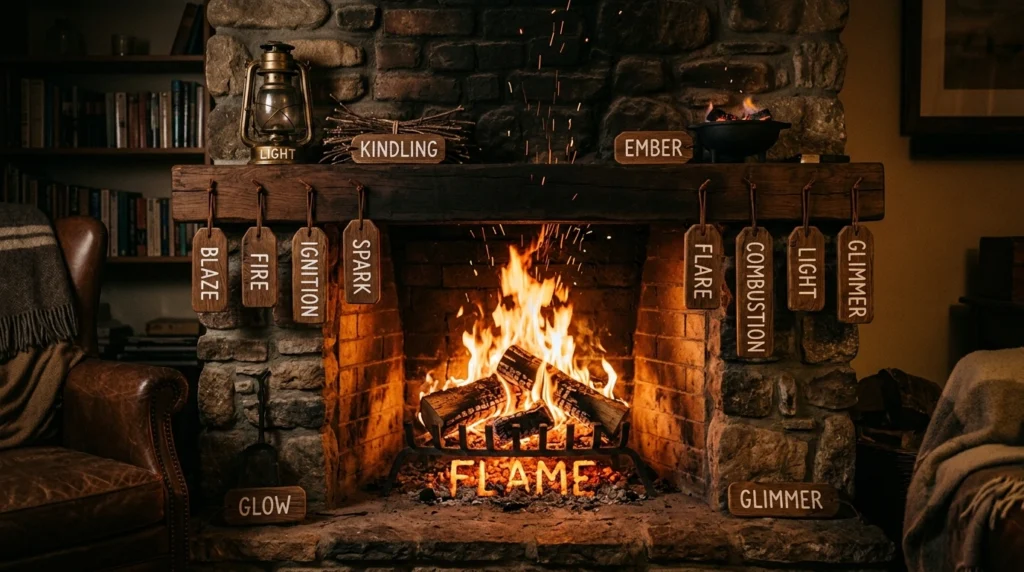
What Does “Flame” Mean?
The word flame has several meanings, so its best synonym depends on the context. As a noun, it can mean the visible burning part of a fire, a strong passion or emotion, or figuratively a romantic partner or interest. As a verb, flame can mean to burn, to criticize someone harshly online, or to ignite and intensify something.
Common synonyms include fire, blaze, firelight, glow, inferno, spark, passion, ardor, intensity, burn, ignite, kindle, and inflame. However, these are not interchangeable in every sentence.
Quick Answer: Synonyms for Flame
The closest synonym depends on what flame means in your sentence:
Fire — general burning or combustion
Blaze — large, bright, strongly burning fire
Firelight — light produced by a fire
Glow — soft light or radiance
Inferno — extremely large or destructive fire
Flicker — unsteady movement of a small flame
Ember — glowing remains of a fire
Spark — tiny fiery particle or beginning of something
Firebrand — a person who inspires strong political or social action
Passion — intense emotion or enthusiasm
Ardor — intense enthusiasm or love
Fervor — passionate intensity
Desire — strong wanting or longing
Romance — romantic relationship or feeling
Love — deep affection
Burn — to produce heat or consume by fire
Blaze — to burn brightly
Ignite — to set on fire or trigger something
Kindle — to start a fire or encourage a feeling
Inflame — to intensify an emotion or conflict
Enkindle — to ignite or awaken a feeling
Quick List of Synonyms for Flame
| Synonym | Best Use |
|---|---|
| Fire | General burning substance or phenomenon |
| Blaze | Large, bright, powerful fire |
| Inferno | Huge or destructive fire |
| Firelight | Light from a fire |
| Glow | Soft light or radiance |
| Flicker | Unsteady movement of light or flame |
| Ember | Glowing piece left from a fire |
| Spark | Tiny fiery particle or beginning |
| Conflagration | Large destructive fire |
| Firebrand | Fiery or provocative person |
| Passion | Strong emotion or enthusiasm |
| Ardor | Intense enthusiasm or love |
| Fervor | Powerful emotional intensity |
| Desire | Strong longing |
| Romance | Romantic attachment |
| Love | Deep affection |
| Burn | Consume or damage with fire |
| Ignite | Set alight or trigger |
| Kindle | Start or intensify |
| Inflame | Intensify emotion or conflict |
| Enkindle | Awaken or inspire |
| Smolder | Burn slowly without a visible flame |
| Scorch | Burn the surface of something |
| Sear | Burn intensely |
| Blazing | Burning or shining intensely |
Closest Synonyms for Flame
1. Fire
Fire is the broadest and most common alternative to flame. A flame is actually one visible part of a fire, so the two words overlap but are not always exact substitutes.
The flames rose above the roof.
The fire rose above the roof.
The second sentence changes the focus from the visible flames to the fire itself.
Best for: General descriptions of burning, heat, and combustion.
2. Blaze
Blaze describes a large, bright, or intensely burning fire.
The flames lit up the night.
The blaze lit up the night.
It is often more dramatic than flame.
Tone: Strong and vivid.
3. Inferno
An inferno is a very large, intense, and often destructive fire.
The building was engulfed in flames.
The building was engulfed in an inferno.
Inferno should not be used for an ordinary candle or campfire because it implies extreme intensity.
4. Firelight
Firelight refers specifically to the light produced by a fire.
The flames illuminated the room.
The firelight illuminated the room.
It is not a direct synonym for the fire itself.
Best for: Descriptions of atmosphere, lighting, and cozy settings.
5. Glow
Glow describes a soft, steady light rather than a visible flame itself.
The flames cast a warm light.
The glow cast a warm light.
It works especially well when describing the light or warmth surrounding a fire.
6. Flicker
Flicker describes an unsteady movement of light or flame.
The candle flame flickered.
The candle flickered.
As a noun, flicker can also refer to a brief or unsteady flash of light.
7. Ember
An ember is a small piece of burning or glowing material left after a fire has partly died down.
The flames had disappeared, leaving only embers.
Ember is related to flame but is not a direct synonym.
8. Spark
A spark is a tiny glowing particle of burning material. Figuratively, it can mean the beginning of an emotion, idea, conflict, or relationship.
A spark flew from the fire.
It can also describe the beginning of passion:
There was a spark between them.
9. Conflagration
Conflagration is a formal word for a large and destructive fire.
The town was damaged by a massive conflagration.
Tone: Formal and dramatic.
It is generally inappropriate for a small flame.
Synonyms for Flame as Passion or Emotion
Flame can be used figuratively to describe intense emotion, enthusiasm, love, or desire.
For example:
Her creative flame never died.
Possible alternatives include:
Passion
Ardor
Fervor
Enthusiasm
Desire
Intensity
Zeal
Drive
Spirit
Love
Affection
Devotion
Excitement
Inspiration
Passion
Passion is probably the closest figurative alternative when flame means intense emotion or enthusiasm.
He kept the flame of his ambition alive.
He kept his passion for his ambition alive.
More naturally:
He kept his passion for his work alive.
Ardor
Ardor means intense enthusiasm, affection, or passion.
She pursued her goals with great ardor.
It is more formal and literary than passion.
Fervor
Fervor means intense and passionate feeling.
The movement was fueled by political fervor.
It often appears in formal writing.
Zeal
Zeal refers to energetic enthusiasm or dedication toward a cause or activity.
His zeal for the project impressed everyone.
It is especially useful when the flame metaphor refers to motivation or dedication.
Synonyms for a Romantic Flame
When flame refers to romance, attraction, or a romantic interest, possible alternatives include:
Love
Passion
Romance
Attraction
Desire
Affection
Beloved
Lover
Romantic interest
Partner
Sweetheart
Example
She was an old flame of his.
Possible alternatives:
She was an old love of his.
She was a former romantic partner.
She was a former romantic interest.
Old flame is an idiomatic expression, so there is no perfect one-word replacement in every sentence.
Synonyms for “Old Flame”
An old flame is a person with whom someone once had a romantic relationship or strong romantic feelings.
Useful alternatives include:
Former lover
Former partner
Former romantic partner
Former love
Past love
Former romantic interest
Ex-partner
Ex-lover
Past relationship
Example
He ran into an old flame at the reunion.
He ran into a former romantic partner at the reunion.
The original expression is usually more natural and conversational.
Synonyms for Flame as a Verb
When flame is used as a verb, its meaning changes.
1. Burn
The logs flamed brightly.
The logs burned brightly.
Burn is the most general alternative.
2. Ignite
Ignite means to set something on fire or cause it to begin burning.
The spark flamed the dry grass.
More naturally:
The spark ignited the dry grass.
It can also be figurative:
The incident ignited public anger.
3. Kindle
Kindle means to start a fire or gradually awaken a feeling.
The conversation kindled her interest.
The conversation sparked her interest.
The conversation kindled her curiosity.
It often has a warm or literary quality.
4. Inflame
Inflame means to intensify an emotion, argument, conflict, or reaction.
His comments inflamed the dispute.
His comments intensified the dispute.
It is particularly useful when describing anger or conflict.
5. Enkindle
Enkindle means to ignite or awaken something, especially an emotion or passion.
The speech enkindled a sense of hope.
It is formal and literary.
Formal Synonyms and Related Alternatives
For formal or literary writing, consider:
Conflagration
Inferno
Combustion
Ignition
Incandescence
Ardor
Fervor
Zeal
Enkindle
Inflame
Kindle
Ignite
Not all of these are direct synonyms. Some describe processes, effects, emotions, or actions related to flame.
Combustion
Combustion is the scientific process of burning.
The flame resulted from combustion.
It should not replace flame when referring to the visible burning phenomenon.
Incandescence
Incandescence describes light produced by intense heat.
The metal glowed with incandescence.
This is a technical or literary alternative to the glow associated with intense heat.
Casual Alternatives for Flame
In everyday language, depending on the meaning, you might use:
Fire
Blaze
Spark
Glow
Burn
Passion
Love
Crush
Romance
Ex
Old love
For example:
There was a flame between them.
In casual conversation:
There was a spark between them.
This sounds more natural when talking about romantic chemistry.
Flame Synonyms by Context
Flame of a Candle
Best alternatives:
Fire
Glow
Flicker
Light
The candle flame flickered.
The candle light flickered.
The candle cast a warm glow.
Flame of a Fire
Best alternatives:
Blaze
Fire
Firelight
Glow
Flicker
Inferno
The flames danced in the fireplace.
The firelight danced across the walls.
Flame of Passion
Best alternatives:
Passion
Ardor
Fervor
Desire
Intensity
Zeal
The flame of her passion never faded.
Her passion never faded.
Flame of Love
Best alternatives:
Love
Passion
Romance
Affection
Desire
Devotion
Spark
They kept the flame of love alive.
They kept their love alive.
Flame as a Romantic Partner
Best alternatives:
Lover
Former lover
Former partner
Romantic interest
Ex
Past love
He met an old flame.
He met an old romantic interest.
True Synonyms vs. Related Alternatives
| Word | Meaning | Relationship to “Flame” |
|---|---|---|
| Fire | Burning material/process | Close synonym in some contexts |
| Blaze | Large, bright fire | Close synonym |
| Inferno | Huge destructive fire | Stronger related alternative |
| Firelight | Light from fire | Related, not interchangeable |
| Glow | Soft radiance | Related |
| Flicker | Unsteady light/flame movement | Related |
| Ember | Glowing remains of fire | Related |
| Spark | Tiny fiery particle or beginning | Related |
| Conflagration | Large destructive fire | Formal related alternative |
| Passion | Intense emotion | Figurative synonym |
| Ardor | Intense love or enthusiasm | Figurative synonym |
| Fervor | Intense passion | Figurative synonym |
| Zeal | Energetic enthusiasm | Contextual alternative |
| Love | Deep affection | Figurative alternative |
| Romance | Romantic feeling/relationship | Contextual alternative |
| Burn | Consume by fire | Verb-related alternative |
| Ignite | Set alight | Verb-related alternative |
| Kindle | Start or intensify | Verb-related alternative |
| Inflame | Intensify emotion/conflict | Verb-related alternative |
Comparison Table: Choosing the Best Alternative
| Alternative | Meaning | Tone | Strength | Best Use |
|---|---|---|---|---|
| Fire | General burning | Neutral | Medium | Everyday descriptions |
| Blaze | Large bright fire | Vivid | High | Dramatic fire |
| Inferno | Massive destructive fire | Dramatic | Very high | Disasters |
| Glow | Soft light | Neutral | Low | Firelight/appearance |
| Spark | Tiny fire or beginning | Neutral | Low | Fire/romance/ideas |
| Ember | Glowing fire remains | Literary | Medium | Dying fires |
| Passion | Strong emotion | Neutral | High | Love/ambition |
| Ardor | Intense passion | Formal | High | Love/enthusiasm |
| Fervor | Strong passionate feeling | Formal | High | Causes/beliefs |
| Zeal | Energetic dedication | Neutral/formal | High | Work/causes |
| Ignite | Set alight or trigger | Neutral | High | Verb/action |
| Kindle | Start or encourage | Literary | Medium | Fire/emotions |
| Inflame | Intensify | Formal | High | Anger/conflict |
| Conflagration | Destructive fire | Formal | Very high | Large fires |
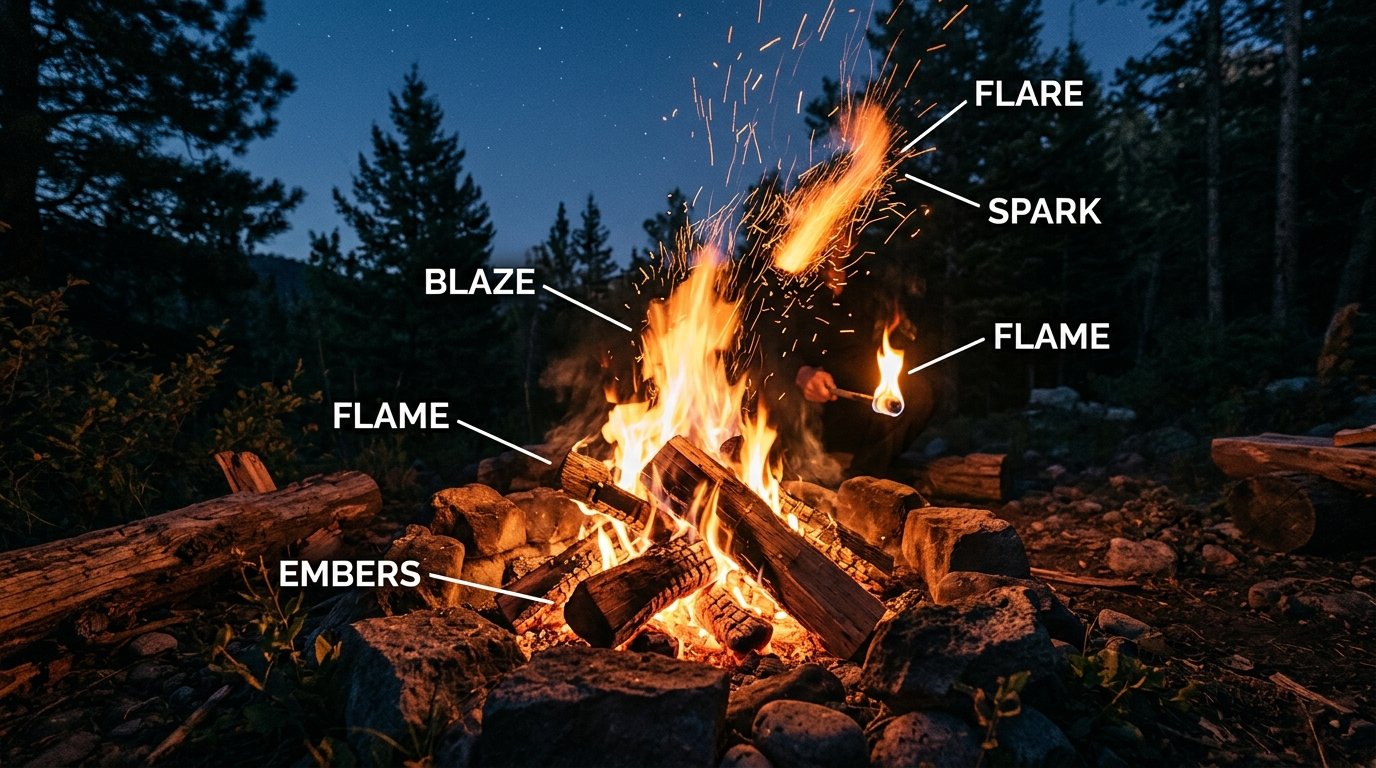
How to Choose the Right Synonym for “Flame”
If you mean a normal fire
Choose fire.
The flame was bright.
The fire was bright.
If you mean a large, powerful fire
Choose blaze.
Flames could be seen from miles away.
A blaze could be seen from miles away.
If you mean a huge destructive fire
Choose inferno or conflagration.
The building was engulfed in an inferno.
If you mean soft light
Choose glow or firelight.
The flames filled the room with light.
The firelight filled the room with warmth.
If you mean romantic chemistry
Choose spark, passion, or romance.
There was a flame between them.
There was a spark between them.
If you mean intense enthusiasm
Choose passion, ardor, fervor, or zeal.
Her flame for music never disappeared.
Her passion for music never disappeared.
If you mean starting something
Choose ignite or kindle.
The event flamed his interest in science.
The event kindled his interest in science.
Sentence Transformations
1. Original
The flames grew higher as the wind increased.
Better alternative:
The blaze grew more intense as the wind increased.
Why: Blaze gives the fire a stronger, more dramatic quality.
2. Original
The candle flame filled the room with warmth.
Better alternative:
The candle’s glow filled the room with warmth.
Why: Glow focuses on the soft light rather than the physical flame.
3. Original
The fire spread quickly, and the flames became enormous.
Better alternative:
The fire spread quickly and became an inferno.
Why: Inferno efficiently conveys an enormous, destructive fire.
4. Original
She never lost the flame of her ambition.
Better alternative:
She never lost her passion for her ambitions.
Why: Passion is more natural when referring to sustained motivation.
5. Original
There was a flame between the two characters.
Better alternative:
There was a spark between the two characters.
Why: Spark is a natural metaphor for initial romantic chemistry.
6. Original
His speech flamed their anger.
Better alternative:
His speech inflamed their anger.
Why: Inflame is the established verb for intensifying strong emotions.
7. Original
The dry leaves caught flame.
Better alternative:
The dry leaves caught fire.
Why: Catch fire is the standard expression.
8. Original
Her flame for painting remained strong.
Better alternative:
Her passion for painting remained strong.
Why: Passion is clearer and more natural in ordinary prose.
Grammar and Usage of “Flame”
Flame can function as both a noun and a verb.
Flame as a noun
The flame burned brightly.
A flame appeared above the candle.
Flame as a verb
The logs flamed brightly.
The verb is less common in everyday English than burn, blaze, or ignite.
Common phrases with “flame”
A flame burns
A flame flickers
A flame rises
A flame dies
A flame goes out
Keep the flame alive
Fan the flames
A flame of passion
An old flame
Catch fire
Common Expressions with “Flame”
Keep the flame alive
This means to maintain passion, love, enthusiasm, or commitment.
They worked hard to keep the flame alive.
Fan the flames
This means to make an emotion, conflict, or situation stronger.
His comments only fanned the flames of the argument.
An old flame
An old flame is a former romantic partner or someone with whom a person once had romantic feelings.
She bumped into an old flame at the airport.
Go up in flames
This means to burn completely, but it can also describe a plan or project that fails dramatically.
Their business plans went up in flames.
Common Mistakes When Using Flame Synonyms
1. Calling “fire” and “flame” exact synonyms
A flame is the visible gaseous part of a fire. Fire is the broader phenomenon of combustion.
2. Using “inferno” for a small flame
An inferno suggests an enormous and destructive fire.
3. Using “glow” as a direct replacement for every flame
A glow is light or radiance. It does not necessarily involve a visible flame.
4. Confusing “spark” with “flame”
A spark is usually tiny and brief. A flame is an established visible fire.
5. Using “passion” for a literal fire
Passion is a figurative alternative when flame represents intense emotion.
6. Using “old flame” to mean any ex-partner
An old flame specifically suggests a past romantic connection, often with an emotional or nostalgic implication.
7. Using “ignite” when you mean “burn”
Ignite means to start burning or cause something to catch fire. It does not simply mean to remain on fire.
Flame vs. Fire
Fire is broader than flame.
The house was destroyed by fire.
The flames reached the roof.
Use fire when referring to the overall burning process or event. Use flame when focusing on the visible burning part.
Flame vs. Blaze
A blaze is generally larger, brighter, or more intense than an ordinary flame.
A small flame burned on the candle.
A huge blaze consumed the building.
Blaze creates a stronger visual image.
Flame vs. Spark
A spark is usually a tiny particle or brief flash of fire.
A spark flew from the campfire.
A flame is larger and sustained.
The words are also both used metaphorically:
There was a spark between them.
Their flame never died.
The first suggests the beginning of attraction; the second suggests continuing passion.
Flame vs. Passion
When used figuratively, flame can represent strong emotion or enthusiasm.
Passion is more direct and precise.
She kept the flame of her creativity alive.
She maintained her passion for creativity.
Use flame when you want a metaphorical or poetic style. Use passion for straightforward writing.
When Not to Replace “Flame”
Sometimes flame is the most precise or expressive word available.
For example:
The blue flame of the gas burner was steady.
Replacing flame with fire changes the technical meaning.
Likewise:
He was an old flame.
Replacing this with fire would completely destroy the intended meaning.
The best synonym depends on whether flame refers to literal fire, light, emotion, romance, or an action.
Writing Tips for Using Synonyms for Flame
Choose the alternative based on the exact image or meaning you want.
For ordinary fire, use fire.
For an intense fire, use blaze.
For a huge destructive fire, use inferno.
For soft light, use glow or firelight.
For a tiny beginning, use spark.
For romantic chemistry, use spark or passion.
For intense enthusiasm, use passion, ardor, or fervor.
For starting something, use ignite or kindle.
For intensifying anger or conflict, use inflame.
For a former romantic partner, use old flame or former romantic partner.
Avoid replacing flame simply to make your writing sound more sophisticated. A precise, familiar word is usually stronger than an unusual one that changes the meaning.
FAQs About Synonyms for Flame
What is the best synonym for flame?
Fire is the closest general synonym, while blaze is better for an intense fire. For figurative uses, passion, spark, or ardor may be more appropriate.
What is another word for a flame?
Depending on context, you can use fire, blaze, firelight, glow, inferno, flicker, or spark. These words have slightly different meanings and should not always be substituted directly.
What is a strong synonym for flame?
Blaze, inferno, and conflagration are strong alternatives for an intense or destructive fire. For figurative passion, fervor and ardor suggest strong emotion.
What is a synonym for flame in love?
Good alternatives include passion, romance, love, desire, attraction, and spark. Spark is especially natural for describing the beginning of romantic chemistry.
What is another word for an old flame?
You can say former lover, former partner, past love, former romantic interest, ex-partner, or former romantic partner.
What is the difference between flame and fire?
A flame is the visible burning part of a fire, while fire is the broader phenomenon of combustion. They overlap in everyday speech but are not technically identical.
What is the opposite of flame?
For a literal flame, possible opposites include extinguishment, darkness, or cold, depending on context. Figuratively, opposites of a passionate flame might include indifference, apathy, or disinterest.