

Quick Answer
The best synonyms for demanding include challenging, difficult, challenging, rigorous, strenuous, taxing, demanding, exacting, arduous, tough, intensive, burdensome, laborious, difficult, challenging, and high-pressure. For people, useful alternatives include exacting, insistent, demanding, and high-maintenance. The best choice depends on whether demanding refers to difficulty, effort, expectations, time, or a person’s behavior.
Quick Synonym List
Here are 40 useful alternatives to demanding, grouped by meaning:
Difficulty or Effort
Challenging
Difficult
Tough
Arduous
Laborious
Taxing
Strenuous
Grueling
Rigorous
Intensive
Exacting
Trying
Formidable
Onerous
Draining
Time, Energy, or Resources
Time-consuming
Energy-intensive
Resource-intensive
Exhausting
Burdensome
Labor-intensive
Involved
Extensive
High Standards or Expectations
Exacting
Stringent
Rigorous
Discerning
Meticulous
Uncompromising
Perfectionistic
Difficult People or Behavior
Insistent
High-maintenance
Difficult
Exacting
Particular
Uncompromising
Pushy
Needy
Not all of these are interchangeable. Strenuous is mainly about physical effort, rigorous often describes standards or processes, and exacting describes very high standards or requirements.
Closest Synonyms for Demanding
Challenging
Meaning: Requiring significant skill, effort, or thought.
Tone: Neutral to positive.
Best for: Jobs, tasks, exams, projects, and personal goals.
Example:
The course was challenging but rewarding.
Watch out: Challenging is often less negative than demanding. It can suggest that difficulty is valuable or stimulating.
Difficult
Meaning: Not easy to accomplish, understand, or deal with.
Tone: Neutral.
Best for: Almost any situation involving difficulty.
Example:
It was a difficult assignment.
Watch out: Difficult is broader than demanding. Something can be difficult because it is confusing, while something demanding may require a large amount of time or effort.
Tough
Meaning: Difficult to complete, handle, or endure.
Tone: Conversational.
Best for: Everyday speech, physical challenges, difficult situations, and informal writing.
Example:
It was a tough week at work.
Watch out: Tough is less formal than demanding.
Arduous
Meaning: Requiring a great deal of effort, especially over a long period.
Tone: Formal.
Best for: Long tasks, journeys, projects, processes, and physical or mental work.
Example:
Completing the restoration was an arduous process.
Watch out: It emphasizes sustained effort rather than simply high expectations.
Taxing
Meaning: Requiring considerable physical or mental effort.
Tone: Neutral to formal.
Best for: Mental tasks, responsibilities, work, and difficult experiences.
Example:
Managing the crisis was mentally taxing.
Watch out: Taxing often emphasizes the toll something takes on your energy or concentration.
Strenuous
Meaning: Requiring a lot of physical effort.
Tone: Neutral to formal.
Best for: Exercise, physical work, activities, and exertion.
Example:
The hike involved several hours of strenuous climbing.
Watch out: Use strenuous mainly for physical effort. It is not a universal synonym for demanding.
Rigorous
Meaning: Extremely thorough, strict, or demanding.
Tone: Formal and professional.
Best for: Training, testing, research, standards, education, and procedures.
Example:
The program has a rigorous training schedule.
Watch out: Rigorous often suggests strictness or thoroughness in addition to difficulty.
Exacting
Meaning: Requiring a high level of skill, care, accuracy, or effort.
Tone: Formal.
Best for: Standards, requirements, jobs, employers, customers, and processes.
Example:
The position requires exacting attention to detail.
Watch out: This is one of the strongest choices when demanding means requiring very high standards.
Intensive
Meaning: Concentrated and involving a large amount of effort, activity, or attention within a limited period.
Tone: Neutral to formal.
Best for: Courses, training, treatment, work, research, and programs.
Example:
She completed an intensive language course.
Watch out: Intensive emphasizes concentration and depth, not necessarily difficulty.
Grueling
Meaning: Extremely tiring and difficult.
Tone: Strong and often negative.
Best for: Long physical activities, schedules, competitions, and exhausting work.
Example:
The athletes completed a grueling training session.
Watch out: This is much stronger than ordinary demanding.
Formal and Professional Alternatives
Onerous
Meaning: Involving a heavy burden or difficult responsibility.
Tone: Formal.
Best for: Duties, obligations, contracts, regulations, and responsibilities.
Example:
The new reporting requirements created an onerous administrative burden.
Watch out: It usually has a negative connotation.
Laborious
Meaning: Requiring considerable time and effort.
Tone: Formal.
Best for: Processes, manual work, calculations, research, and repetitive tasks.
Example:
The team used software to simplify the laborious process.
Stringent
Meaning: Very strict and difficult to satisfy.
Tone: Formal.
Best for: Rules, requirements, regulations, standards, and conditions.
Example:
The application process has stringent eligibility requirements.
Watch out: Stringent describes strictness, not general difficulty.
Formidable
Meaning: Very difficult or impressive because of its size, strength, or difficulty.
Tone: Formal.
Best for: Challenges, opponents, tasks, obstacles, and responsibilities.
Example:
The researchers faced a formidable challenge.
Extensive
Meaning: Large in scope, range, or amount.
Best for: Work, preparation, research, requirements, and responsibilities.
Example:
The project required extensive preparation.
Watch out: Extensive describes scope or amount, not necessarily difficulty.
Synonyms for a Demanding Person
When demanding describes a person, the meaning changes. It may refer to someone who expects a lot from others, has high standards, or requires constant attention.
Exacting
She is an exacting manager who expects every detail to be correct.
This suggests high standards, not necessarily unreasonable behavior.
Insistent
The client was insistent on receiving the report by Friday.
This emphasizes that someone strongly refuses to change their request.
Particular
He’s very particular about how the work is presented.
This suggests someone has specific preferences or standards.
High-Maintenance
The customer can be quite high-maintenance.
This is informal and usually suggests that someone requires excessive attention, effort, or accommodation.
Pushy
The salesperson became pushy after I said I needed more time.
This suggests excessive pressure and is usually negative.
Uncompromising
The manager was uncompromising about safety standards.
This means the person is unwilling to lower or change their standards.
Needy
The child became increasingly needy after the move.
This suggests someone requires a lot of emotional attention or reassurance.
Important: These words are not interchangeable. Calling someone demanding is more neutral than calling them pushy or needy.
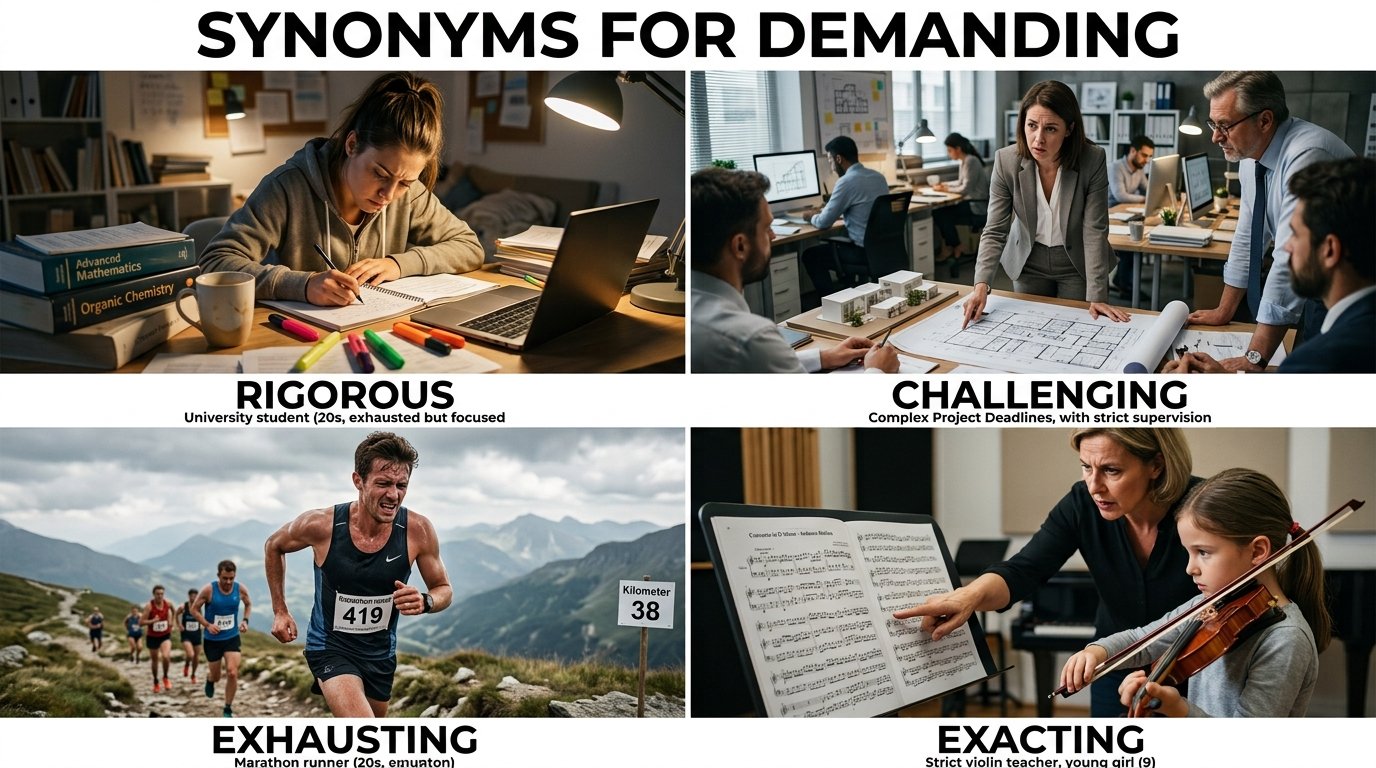
Synonyms for a Demanding Job
For a demanding job, the best alternative depends on what makes the job demanding:
Challenging — requires skill or problem-solving.
Intensive — involves concentrated effort.
High-pressure — involves stress or tight deadlines.
Taxing — consumes mental or physical energy.
Arduous — requires sustained effort.
Rigorous — involves strict standards or procedures.
Time-consuming — requires a lot of time.
Stressful — creates significant emotional or mental pressure.
Labor-intensive — requires substantial human effort.
For example:
She has a demanding job.
could become:
She has a high-pressure job with tight deadlines.
or:
She has an intensive role that requires constant attention.
The best replacement tells the reader why the job is demanding.
True Synonyms vs. Related Alternatives
| Alternative | Relationship | Can Replace “Demanding”? | Best Context |
|---|---|---|---|
| Challenging | Near synonym | Usually | Tasks and goals |
| Difficult | Near synonym | Usually | General difficulty |
| Tough | Near synonym | Usually | Casual conversation |
| Arduous | Strong synonym | Often | Sustained effort |
| Taxing | Contextual synonym | Often | Mental/physical strain |
| Strenuous | Narrower synonym | Sometimes | Physical effort |
| Rigorous | Contextual synonym | Sometimes | Standards/training |
| Exacting | Contextual synonym | Sometimes | High standards |
| Intensive | Contextual synonym | Sometimes | Concentrated activity |
| Grueling | Strong contextual synonym | Sometimes | Extreme exhaustion |
| Onerous | Contextual synonym | Sometimes | Heavy burdens |
| Stringent | Narrower alternative | Sometimes | Strict requirements |
| Insistent | Contextual alternative | No, not generally | People |
| High-maintenance | Informal alternative | Context-dependent | People |
| Pushy | Negative alternative | No, not generally | People/behavior |
Comparison Table
| Word/Phrase | Meaning | Tone | Intensity | Best Use | Interchangeable? |
|---|---|---|---|---|---|
| Challenging | Requires skill or effort | Neutral/Positive | Medium | Tasks, work | Usually |
| Difficult | Not easy | Neutral | Medium | General | Usually |
| Tough | Hard to handle | Casual | Medium | Everyday situations | Usually |
| Arduous | Requires sustained effort | Formal | High | Long tasks | Often |
| Taxing | Drains energy | Neutral/Formal | High | Mental/physical work | Often |
| Strenuous | Requires physical effort | Formal | High | Exercise/work | Sometimes |
| Rigorous | Strict and thorough | Formal | High | Training/standards | Sometimes |
| Exacting | Requires high standards | Formal | High | Requirements/people | Sometimes |
| Intensive | Highly concentrated | Neutral/Formal | Medium-High | Courses/work | Sometimes |
| Grueling | Extremely exhausting | Strong | Very high | Training/work | Sometimes |
| Onerous | Heavy or burdensome | Formal | High | Duties/obligations | Sometimes |
| High-maintenance | Requires excessive attention | Informal | Medium-High | People | Context-dependent |
How to Choose the Right Alternative
For a Difficult Task
Choose challenging, difficult, or tough.
The assignment was challenging.
For a Long and Exhausting Task
Choose arduous, laborious, or taxing.
The restoration was an arduous undertaking.
For Physical Effort
Choose strenuous, grueling, or taxing.
It was a strenuous workout.
For Strict Requirements
Choose stringent, rigorous, or exacting.
The company has stringent safety requirements.
For High Standards
Choose exacting.
The editor has exacting standards.
For Concentrated Work
Choose intensive.
The team completed an intensive training program.
For a Difficult Person
Choose according to the exact behavior:
High standards → exacting
Strong insistence → insistent
Excessive attention required → high-maintenance
Excessive pressure → pushy
Specific preferences → particular
Refuses compromise → uncompromising
Sentence Transformations
1. General Difficulty
Original:
The project was demanding.
Better Alternative:
The project was challenging.
Why:
Challenging communicates difficulty while sounding slightly more positive and constructive.
2. Physical Effort
Original:
The workout was demanding.
Better Alternative:
The workout was strenuous.
Why:
Strenuous specifically identifies the physical effort involved.
3. Mental Effort
Original:
The exam was demanding.
Better Alternative:
The exam was mentally taxing.
Why:
This makes the source of the difficulty clear.
4. High Standards
Original:
The client was demanding.
Better Alternative:
The client was exacting.
Why:
Exacting suggests that the client expected a very high level of accuracy or quality.
5. Strict Rules
Original:
The company has demanding safety standards.
Better Alternative:
The company has stringent safety standards.
Why:
Stringent specifically means strict and difficult to satisfy.
6. Long Process
Original:
The process was demanding.
Better Alternative:
The process was laborious.
Why:
Laborious emphasizes the amount of work and time involved.
7. Concentrated Training
Original:
She completed a demanding training program.
Better Alternative:
She completed an intensive training program.
Why:
Intensive emphasizes concentrated effort over a particular period.
8. Extreme Difficulty
Original:
The expedition was demanding.
Better Alternative:
The expedition was grueling.
Why:
Grueling communicates an especially high level of exhaustion and difficulty.
Grammar and Usage
Demanding is the present participle of demand, but it commonly functions as an adjective.
It can describe:
A person: a demanding manager
A task: a demanding assignment
A job: a demanding career
A process: a demanding procedure
An activity: a demanding workout
Requirements: demanding standards
The structure is generally straightforward:
demanding + noun
a demanding job
a demanding course
It can also appear after linking verbs:
The course was demanding.
The key grammatical issue is less about demanding itself and more about choosing an alternative that fits the noun.
For example:
a strenuous workout
sounds natural.
But:
a strenuous customer
does not.
Likewise:
an exacting customer
is natural, while:
an exacting workout
would usually mean something different or sound unusual.
Common Mistakes
1. Treating Every Synonym as Interchangeable
Strenuous, rigorous, exacting, and stringent each have specific uses.
Choose based on what makes something demanding.
2. Using “Strenuous” for Mental Difficulty
Strenuous usually refers to physical exertion.
For mental difficulty, taxing, challenging, or demanding may be better.
3. Using “Stringent” for a Difficult Person
Stringent describes strict rules, requirements, or conditions.
stringent regulations
Not:
a stringent customer
4. Using “Grueling” for Mild Difficulty
Grueling is strong. It suggests extreme tiredness or hardship.
If a task was simply difficult, challenging is more appropriate.
5. Assuming “Challenging” Is Always Negative
Challenging can have a positive meaning.
It was a challenging but rewarding project.
6. Using “High-Maintenance” in Formal Writing
This phrase is informal and can sound judgmental.
For professional writing, describe the actual behavior instead.
The client required frequent revisions.
This is clearer than:
The client was high-maintenance.
7. Confusing “Demanding” With “Demanding Too Much”
A demanding person is not necessarily unreasonable. They may simply have high standards.
Words such as pushy, unreasonable, or controlling add stronger negative meanings.
8. Using “Difficult” When You Mean “Time-Consuming”
Something can be easy but take a long time.
The form was time-consuming but not difficult.
In that case, difficult would change the meaning.
Commonly Confused Words
Demanding vs. Difficult
Difficult means not easy.
Demanding often means requiring substantial effort, time, energy, or attention.
The puzzle was difficult.
The project was demanding because it required six months of work.
Demanding vs. Challenging
Both describe difficulty, but challenging often sounds more positive.
The role is demanding but rewarding.
The role is challenging and provides opportunities to learn.
Demanding vs. Strenuous
Demanding can describe mental, physical, emotional, or practical effort.
Strenuous is primarily physical.
Demanding vs. Rigorous
Demanding emphasizes what is required.
Rigorous often emphasizes strictness, thoroughness, or high standards.
Demanding vs. Exacting
Demanding is broad.
Exacting specifically suggests very high standards, precision, or attention to detail.
When Not to Replace Demanding
Sometimes demanding is the most accurate word.
For example:
Being a parent can be demanding.
This communicates that parenting requires considerable time, energy, patience, and attention without claiming that it is necessarily negative.
Replacing it with arduous could make the statement sound excessively harsh.
Likewise:
The job is demanding but rewarding.
This balanced phrase works because demanding acknowledges the effort while rewarding communicates the benefit.
Do not use a stronger synonym just to make your writing sound sophisticated. Grueling, onerous, and exacting should appear only when their specific meanings are justified.
Writing Tips
The best synonym for demanding often answers the question:
What exactly makes it demanding?
It requires skill → challenging
It requires physical effort → strenuous
It drains mental energy → taxing
It requires long-term effort → arduous
It requires very high standards → exacting
It has strict requirements → stringent
It involves concentrated effort → intensive
It causes extreme exhaustion → grueling
It creates a heavy burden → onerous
It requires lots of time → time-consuming
It requires many resources → resource-intensive
This approach gives your reader more information instead of simply swapping one adjective for another.
FAQs
What is the best synonym for demanding?
Challenging is one of the best general alternatives to demanding. Other choices depend on context: strenuous for physical effort, taxing for mental strain, rigorous for strict standards, and exacting for high expectations.
What is a formal synonym for demanding?
Useful formal alternatives include arduous, rigorous, exacting, taxing, onerous, and stringent. Each has a slightly different meaning, so the best choice depends on what makes the situation demanding.
What is another word for a demanding job?
Depending on the context, you can describe a demanding job as challenging, high-pressure, intensive, taxing, strenuous, arduous, or time-consuming. Choose the word that explains the main source of difficulty.
What is a positive synonym for demanding?
Challenging is often the best positive alternative. It can describe something difficult while suggesting that the experience is worthwhile, stimulating, or rewarding.
What is a negative synonym for demanding?
Depending on the context, onerous, burdensome, exhausting, grueling, or high-maintenance may work. These words add stronger negative meanings and should not be used automatically.
What is a synonym for demanding when describing a person?
Useful choices include exacting, insistent, particular, uncompromising, high-maintenance, and pushy. The right word depends on whether the person has high standards, makes frequent requests, refuses compromise, or pressures others.
Is “challenging” the same as “demanding”?
They overlap, but they are not identical. Challenging emphasizes difficulty or the need for skill, while demanding can emphasize the amount of time, energy, attention, or effort required.